he
Greek Orthodox Church of Panagia Paramythia stands in Istanbul's historic Phanar (Fener)
district. Dedicated to
the Holy Mother of Comfort, the sanctuary is widely known as the Vlach-Sarai
church, referencing
its origin as a gift to the Ecumenical Patriarchate from the Wallachian princes. Constructed
around 1578, the
site holds deep historical resonance within Byzantine and post-Byzantine history, having briefly
served as the
seat of the Ecumenical Patriarchate in the late 16th century.
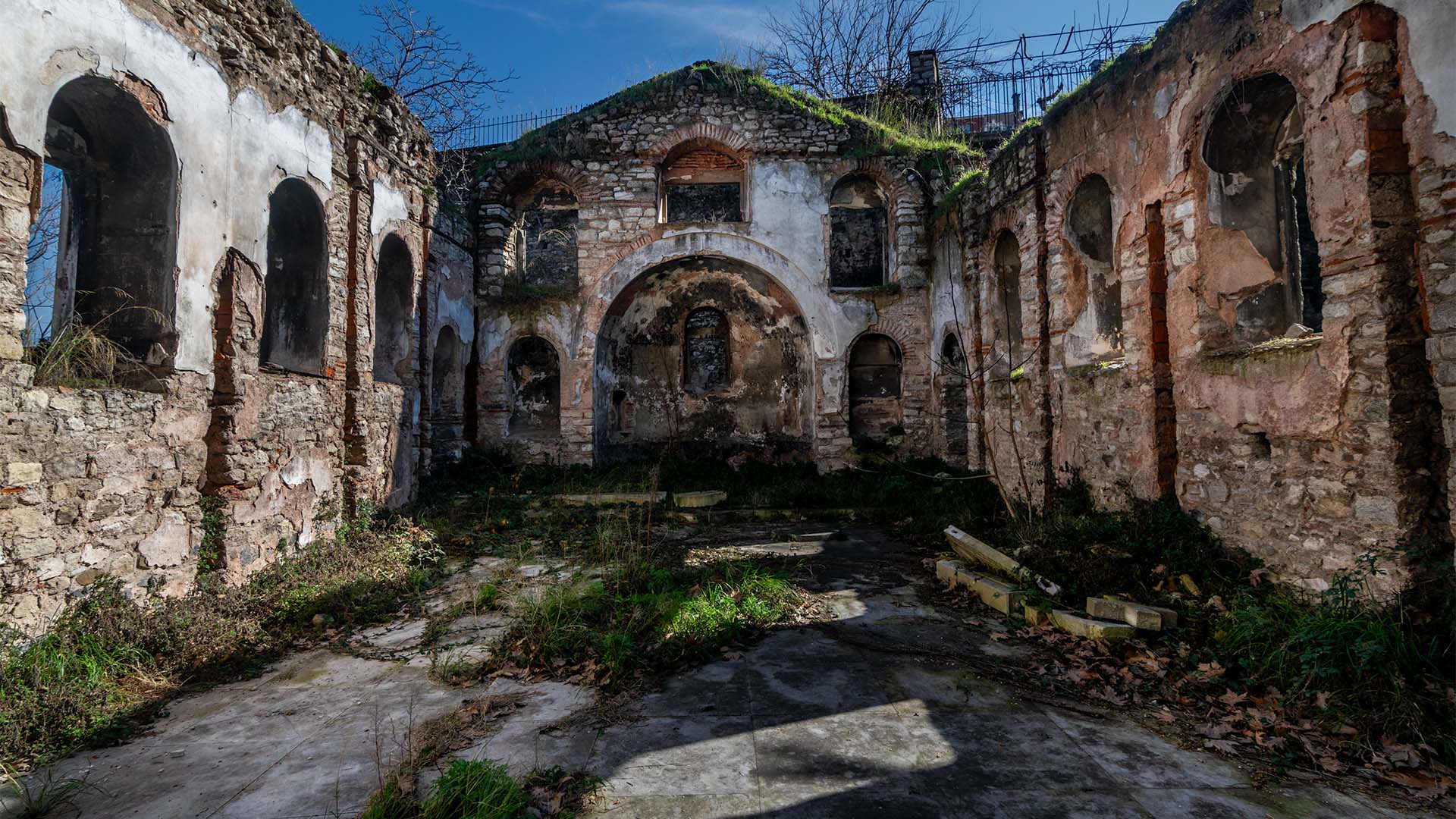
Originally built as a classic rectangular stone basilica coated in plaster, the architecture featured a prominent eastern round arch, a traditional gabled terracotta tile roof, marble slab flooring, and minimalist lighting.
Its elaborate wooden narthex and intricately carved iconostasis were key architectural highlights. Together with three adjoining monastic structures, the church formed a major center of Orthodox spirituality and administration along the Golden Horn.
Throughout its centuries-long history, Panagia Paramythia survived several severe urban fires, prompting major restoration works in 1640 and again in 1729 under Patriarch Jeremias III. An iron bell tower was later added to the grounds in 1833, reflecting 19th-century additions to the architectural complex.
Tragically, a catastrophic fire in 1974 reduced the main structure to ruins, and the surviving ironwork was eventually salvaged over subsequent decades. Despite its present state, the site of Panagia Paramythia remains a monumental landmark in urban archaeological studies, Ottoman-era Greek community heritage, and the institutional history of the Patriarchate in Istanbul.