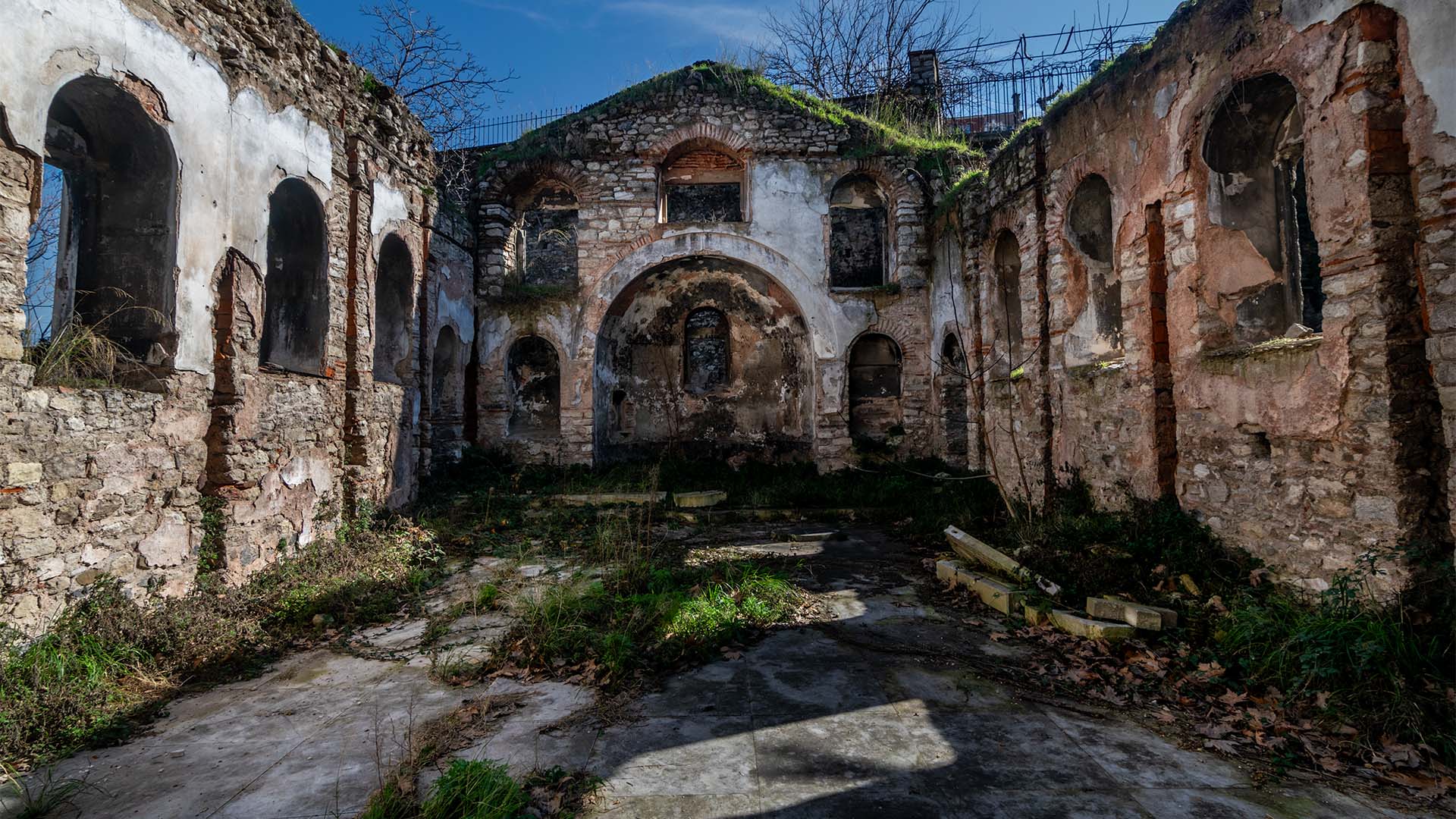
The Greek Orthodox Church of Panagia Paramythia stands in Istanbul's Phanar district, the church's name "Panagia Paramythia" means Holy Mother of Comfort, and the Church is also known as the Vlach-Sarai church because it was donated to the Patriarchate by the Vlach princes. The Panagia Paramythia church was built around 1578.
Panagia Paramythia was originally built as a rectangular stone basilica coated in plaster, featuring a prominent eastern round arch, a gabled terracotta roof, marble slab flooring, and a single window. Its wooden narthex and iconostasis, along with three adjoining structures, formed a significant religious complex in the Phanar (Fener) district of Constantinople/Istanbul. Over the centuries, the church suffered repeated fire damage, leading to major reconstructions in 1640 and 1729. A devastating fire in 1974 destroyed the building completely, and even its iron bell tower, originally erected in 1833, was later stripped for scrap metal.
- The church of Panagia Paramythia is more than just another Orthodox Church. It is a symbol of the integration of the Slavic peoples into the spiritual, social and artistic world of the Ecumenical Patriarchate.
Laki Vingas
Today, Panagia Paramythia remains a significant reference point in the study of Orthodox heritage, Phanar history, and the evolution of the Ecumenical Patriarchate in Istanbul.