Medical Technology & 3D Imaging in Mosaic Conservation
The Pammakaristos Mosaic Icon
Institution: University of West Attica (UNIWA)
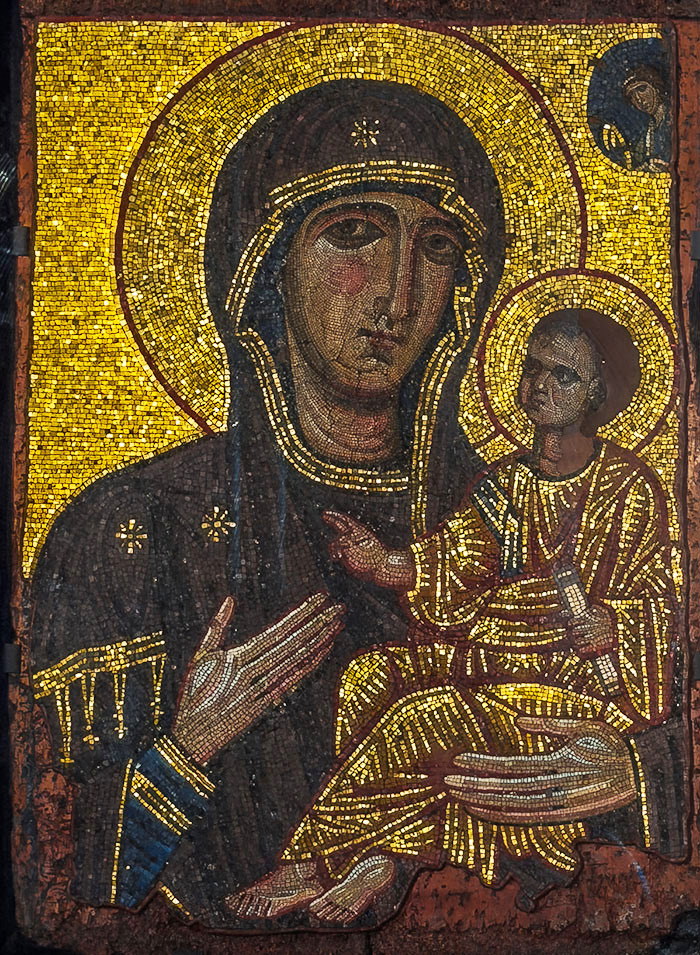 Byzantine mosaic icons are among the rarest treasures of world cultural heritage, with only
around 50 surviving
examples known globally. This study details the non-invasive investigation of the early
12th-century
Pammakaristos icon (92 x 62 cm), housed at the Patriarchal Church of St. George
in Istanbul.
Byzantine mosaic icons are among the rarest treasures of world cultural heritage, with only
around 50 surviving
examples known globally. This study details the non-invasive investigation of the early
12th-century
Pammakaristos icon (92 x 62 cm), housed at the Patriarchal Church of St. George
in Istanbul.
Crafted from minute stone, glass, and gold-leaf tiles set into a delicate mixture of beeswax and
natural resin, the
icon represents a peak of Middle Byzantine luxury art. Because it is a living,
miracle-working
ceremonial artwork, centuries of continuous handling, religious litanies, and severe moisture
fluctuations caused
critical physical damage, loose tiles, and deep cracks in its wooden support.
By combining high-precision dual-energy Computed Tomography (CT-Scan), optical 3D laser
scanning, and
structure-from-motion photogrammetry, conservators mapped the artifact's structural damage and
internal condition
down to 0.6 mm section depth. This non-invasive documentation revealed crucial
insights about past
restorations and paved the way for safe, modern conservation without risking the sacred
artwork.
Key Scientific Discoveries
1. Hidden Masterpiece Revealed
CT coronal sections revealed a hidden painted image of The Crucifixion on the back of the original wooden panel, making it a rare double-sided artwork.
2. Precision Nail Mapping
Radiographs and 3D rendering successfully mapped 221 corroded iron nails added over centuries, enabling safe, surgical extraction.
3. Sub-Millimeter Micro-Relief
3D laser scanning documented surface warping, gaps, and mosaic bulging caused by the aging of the beeswax-rosin bedding mortar.
4. Processional Handle Socket
A carved socket discovered at the base confirms the icon was carried in religious parades, explaining specific patterns of physical wear.
About the Artwork
- Rare Byzantine Category: One of only 11 large-scale portable mosaic icons known to survive from the entire Byzantine period.
- Iconography: Depicts the Virgin Mary holding the infant Christ, with Archangel Gabriel featured in a minute medallion at the upper right corner.
- Physical Materials: Crafted from microscopic stone, colored glass, and gold leaf tiles set into a beeswax and tree resin paste.
Past Restorations & Damage History
- Votive Cover Impact: Until 1933, heavy silver revetments were nailed directly onto the surface, leaving widespread nail damage around the figures.
- 1933 Intervention: Empty mosaic areas were filled with plaster, and original details were obscured by heavy overpainting.
- Secondary Support Panel: A backing board was attached long ago to structurally stabilize the split and insect-damaged primary timber.